15+ Coffee Table Tray Decor Ideas
A Coffee Table Tray Decor Ideas tray isn’t just a decorative accent—it’s the anchoring piece that brings order, intention, and style to your living room’s focal point. Whether you’re corralling remote controls, displaying treasured objects, or creating a mini vignette that sparks conversation, the right tray styling can elevate your entire space from cluttered to curated.
This guide will show you how to style coffee table tray like a professional designer, with practical tips that work for any aesthetic and budget.
Some links in this post are affiliate links. If you purchase through them, I may earn a small commission at no extra cost to you.
1. The Classic Triangle Arrangement
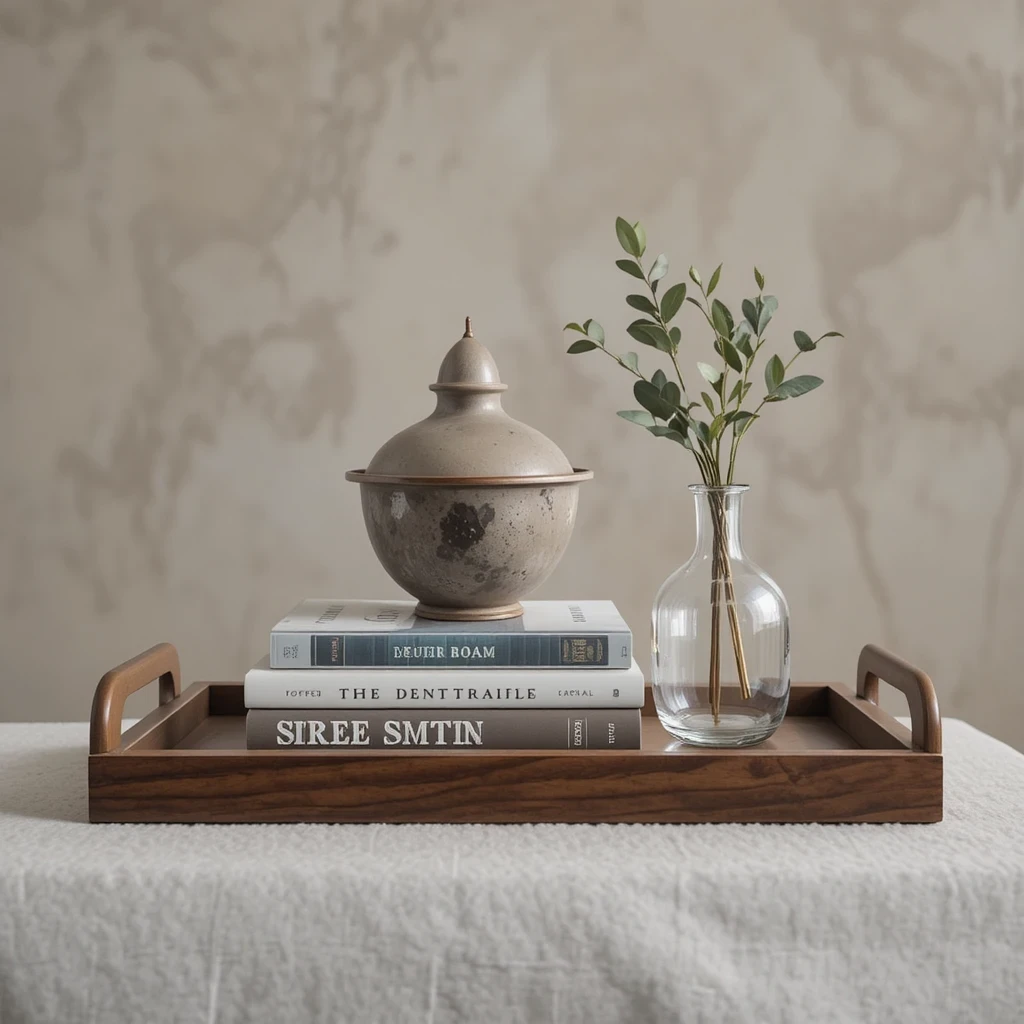
A polished wooden tray anchors three carefully chosen elements: a small stack of coffee table books, a sculptural candle, and a delicate vase with fresh greenery. The items are arranged in a triangular formation, creating visual balance and guiding the eye naturally around the display. Shop on Amazon
Why It Works: The rule of three is design gold because our brains process odd-numbered groupings as more interesting and memorable than even numbers. This arrangement feels intentional without being fussy, and the triangular placement prevents the static feeling of items lined up in a row. It’s sophisticated enough for formal spaces yet approachable for everyday living.
How to Style It:
- Position your tallest item (like a vase or candle) at the back corner, medium item in the opposite back corner, and shortest item in front to create depth
- Maintain 2-3 inches of breathing room between objects so each piece gets its moment
- Choose items in varying textures—smooth ceramic, rough-hewn wood, glossy metal—to add tactile interest
- Keep your color palette to 2-3 coordinating hues plus neutrals for a cohesive, uncluttered look
Where to Use It: Living rooms with traditional or transitional decor, formal sitting areas, coffee tables in master bedrooms, den or library settings
Pro Tip: Place your heaviest or most visually substantial item slightly off-center rather than dead-center in the tray—this asymmetry creates dynamic tension that’s more interesting to the eye than perfect symmetry.
2. The Spa-Inspired Serenity Setup
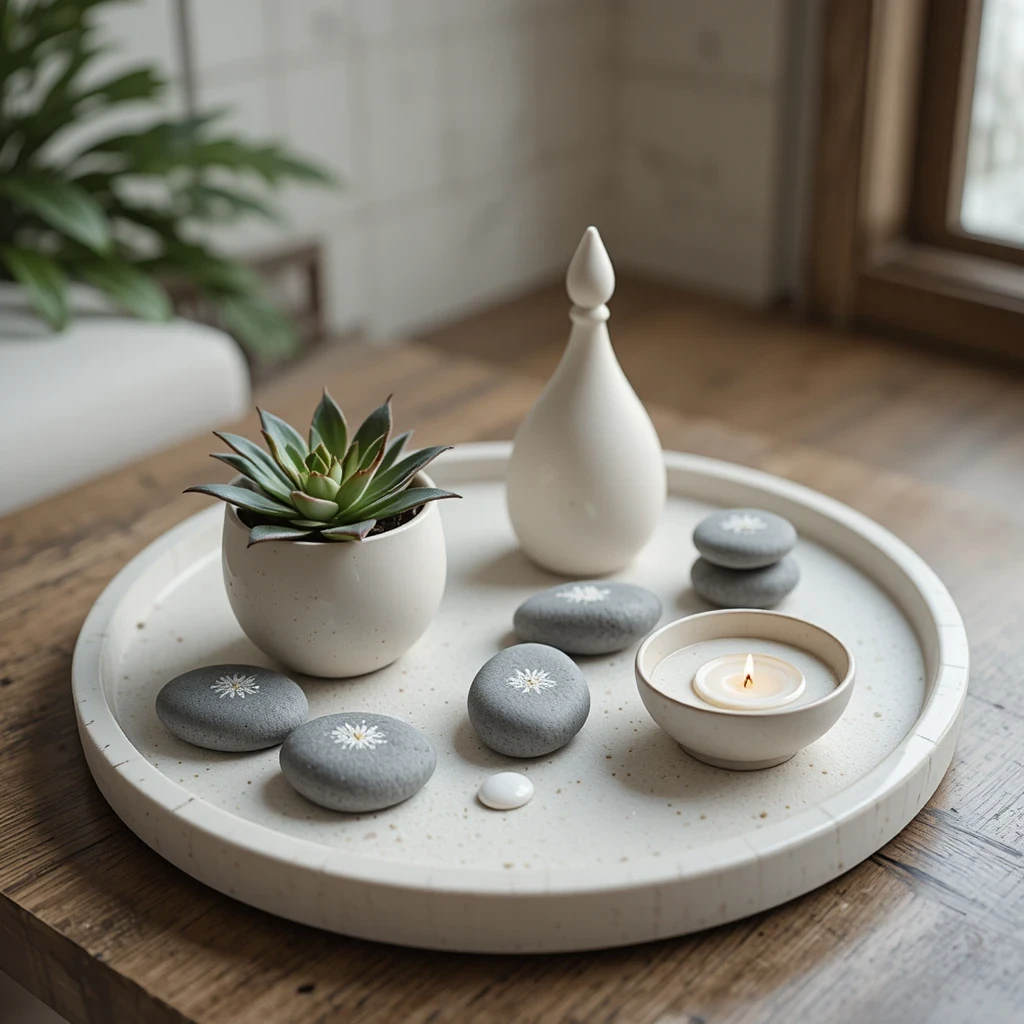
A minimalist white or natural stone tray holds a collection of zen-like elements: a small succulent in a ceramic pot, smooth river stones, a single sculptural object, and perhaps a small dish of decorative sand or a shallow bowl with floating candles. The palette is entirely neutral with organic textures throughout. Shop on Amazon
Why It Works: This styling approach creates an instant sense of calm in your living space, functioning almost like a meditation focal point. The natural materials and restrained color palette trigger our innate response to nature, reducing stress and creating a sanctuary-like atmosphere. It’s particularly effective in homes where the living room serves as a genuine relaxation zone rather than an entertainment hub.
How to Style It:
- Select a tray in natural materials like light wood, marble, or textured ceramic to reinforce the organic theme
- Limit yourself to 3-5 small objects maximum—restraint is essential for achieving that spa-like emptiness
- Incorporate at least one living element (succulent, air plant, or bonsai) to bring authentic life energy to the display
- Add a textural element like smooth stones, dried botanicals, or a small sand garden to engage the sense of touch
Where to Use It: Meditation spaces, minimalist living rooms, bedrooms with sitting areas, yoga or wellness-focused rooms
Pro Tip: Place a drop of essential oil on one of the decorative stones—the subtle fragrance will waft up naturally throughout the day, engaging another sense and deepening the spa atmosphere without the visual bulk of a diffuser.
3. The Stacked Books Foundation
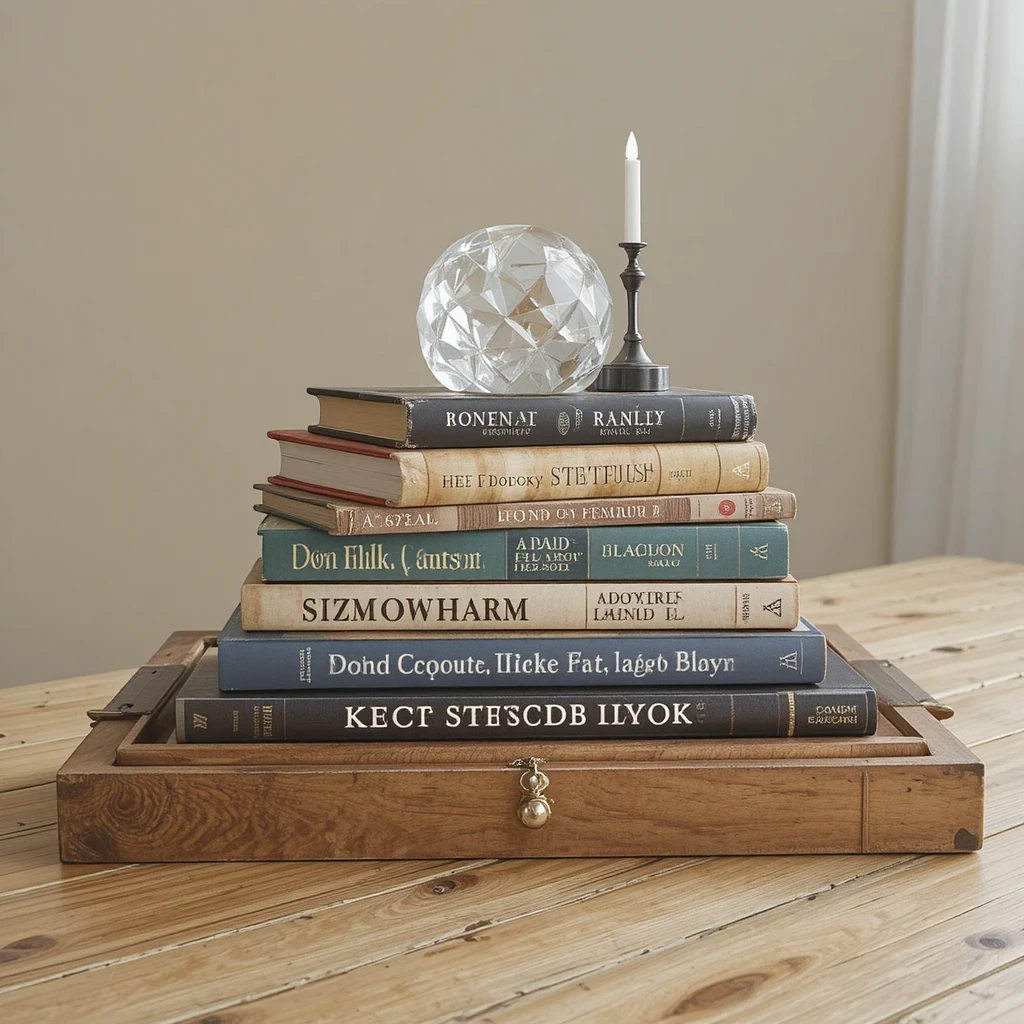
A substantial rectangular tray showcases a curated stack of 3-5 oversized coffee table books as the primary element, topped with a small decorative object like a crystal paperweight, a vintage magnifying glass, or a small sculptural piece. The book spines create a mini art installation while the topper adds personality. Shop on Amazon
Why It Works: Coffee table books serve double duty as both decor and entertainment, giving guests something to flip through while adding instant intellectual cachet to your space. The vertical stacking creates height and architecture on an otherwise flat surface, and the books’ spines become a color story that you can coordinate with your room. This approach is particularly smart for renters or frequent redecorators since you can easily swap books to match evolving color schemes.
How to Style It:
- Choose books with spines that complement your room’s color palette, or turn them spine-in for a uniform neutral look
- Vary book sizes slightly with the largest on bottom, creating a stable pyramid shape that draws the eye upward
- Top your stack with something substantial enough not to blow away but small enough not to overwhelm the books (4-6 inches maximum)
- Layer in a small second stack perpendicular to the first, with one book laid flat, for a more collected-over-time appearance
Where to Use It: Studies and home offices, living rooms with traditional or maximalist decor, spaces where guests gather for conversation
Pro Tip: Rotate your book selection seasonally—design and architecture books in spring, travel photography in summer, art monographs in fall, and cozy narratives in winter—to keep your display feeling fresh without purchasing new decorative objects.
4. The Organic Centerpiece with Natural Elements
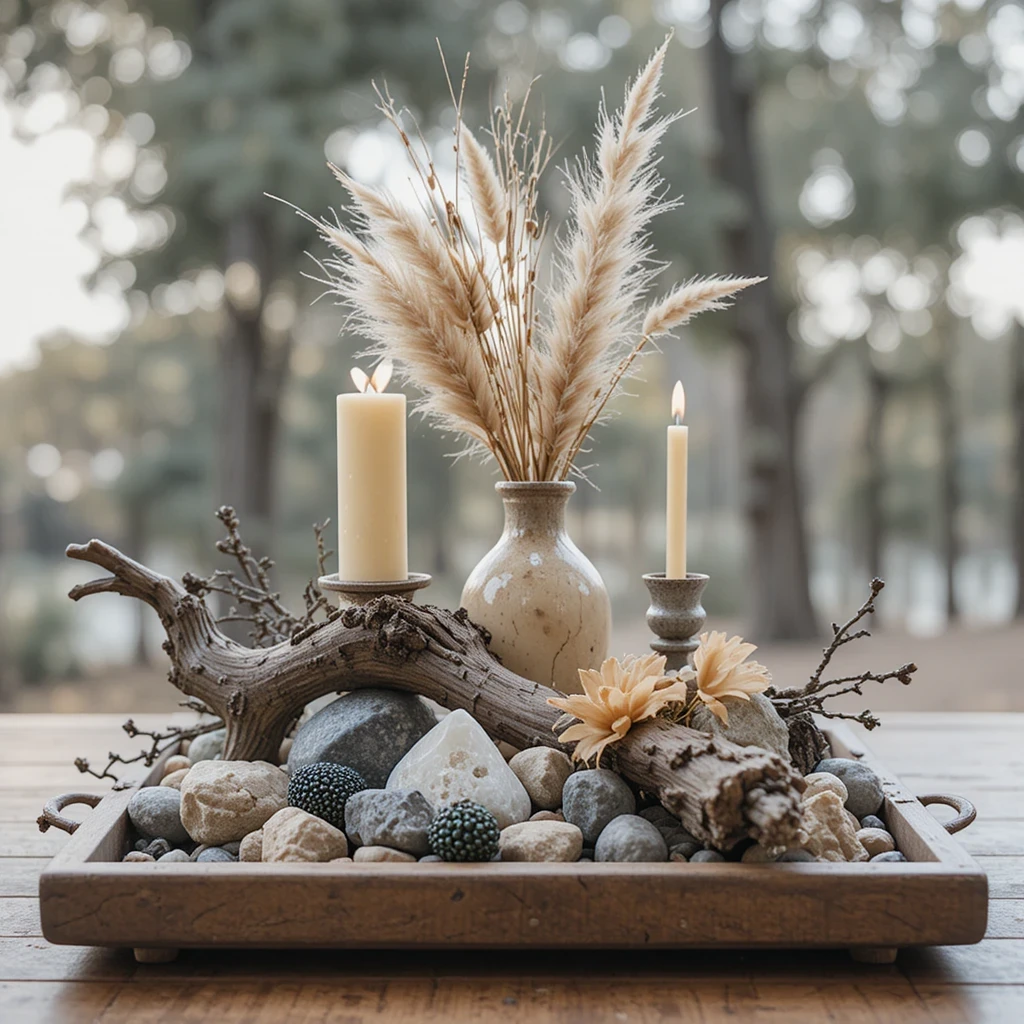
A rustic wooden or woven tray becomes the foundation for an arrangement celebrating nature: a substantial branch or driftwood piece, river rocks or geodes, dried grasses or pampas in a simple vessel, and perhaps a beeswax candle or two. The entire composition has an earthy, collected-from-nature feeling. Shop on Amazon
Why It Works: Biophilic design—incorporating natural elements into indoor spaces—has been proven to reduce stress, improve mood, and increase creativity. This styling approach brings the outside in without the maintenance requirements of living plants, and the organic shapes and textures create visual softness that balances hard-edged modern furniture. It’s particularly effective for adding warmth to contemporary or industrial spaces that might otherwise feel cold.
How to Style It:
- Select one substantial statement piece (large branch, coral specimen, or interesting driftwood) to anchor the arrangement
- Add height variation by incorporating elements of different scales, from tiny pebbles to medium-sized botanical clusters
- Choose a tray that contrasts with your items—a smooth modern tray makes natural elements pop, while a rustic tray creates monochromatic harmony
- Replace or rotate natural elements seasonally: branches with spring buds, summer wildflowers (dried), autumn seed pods, winter evergreen sprigs
Where to Use It: Cabins and vacation homes, living rooms with rustic or farmhouse aesthetics, spaces with lots of natural wood, modern spaces needing warmth
Pro Tip: Forage responsibly for free decor elements on nature walks—fallen branches, interesting rocks, seed pods, or driftwood from beaches—then clean and seal them with a clear spray to preserve their appearance and prevent any insect visitors.
5. The Monochromatic Modern Display
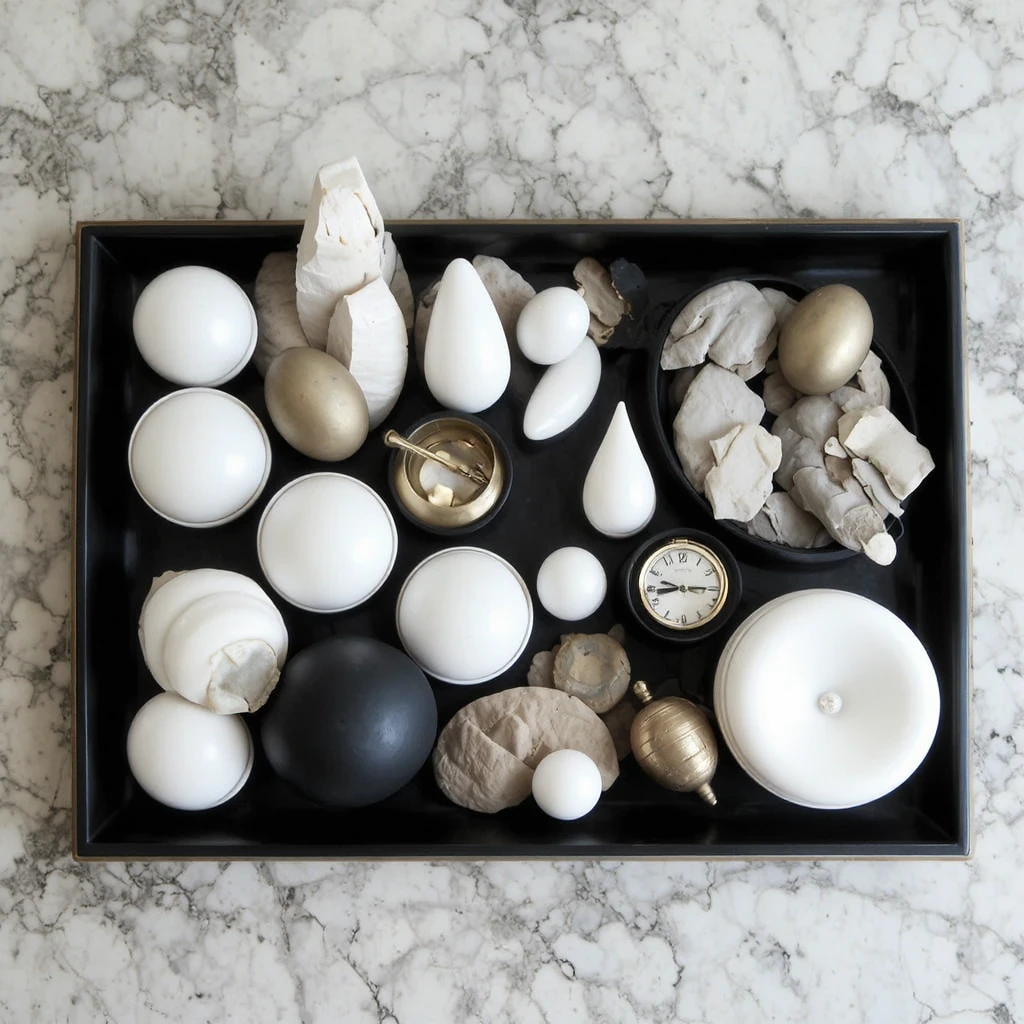
A sleek rectangular tray in black, white, or metallics holds items in a strict single-color family: perhaps all white ceramic pieces of varying shapes, or all black matte objects with different textures, or all brass and gold-toned elements. The visual unity creates a striking, gallery-like effect. Shop on Amazon
Why It Works: Monochromatic styling is a designer’s secret weapon for creating impact without chaos. By removing color as a variable, you force the eye to appreciate form, texture, and negative space—the fundamental building blocks of good design. This approach reads as sophisticated and intentional, and it’s particularly effective in spaces with bold patterned rugs or busy upholstery where you need the coffee table to provide visual calm.
How to Style It:
- Commit fully to your chosen color family, including subtle variations like cream and ivory within “white” or charcoal and jet within “black”
- Mix at least 3-4 different textures within your color family: matte, glossy, rough, smooth, woven, metallic
- Vary heights dramatically—a tall vase next to a flat box next to a medium candle creates rhythm within uniformity
- Include one piece with interesting form or negative space (sculptural ceramic, geometric object) to serve as a focal point
Where to Use It: Modern and contemporary spaces, minimalist homes, rooms with colorful or patterned furniture that need visual rest, gallery-like interiors
Pro Tip: Spray-paint mismatched thrift store finds in your chosen color to create a custom collection for a fraction of retail prices—matte spray paint can make a cheap ceramic vase look like expensive plaster or concrete.
6. The Layered Texture Study
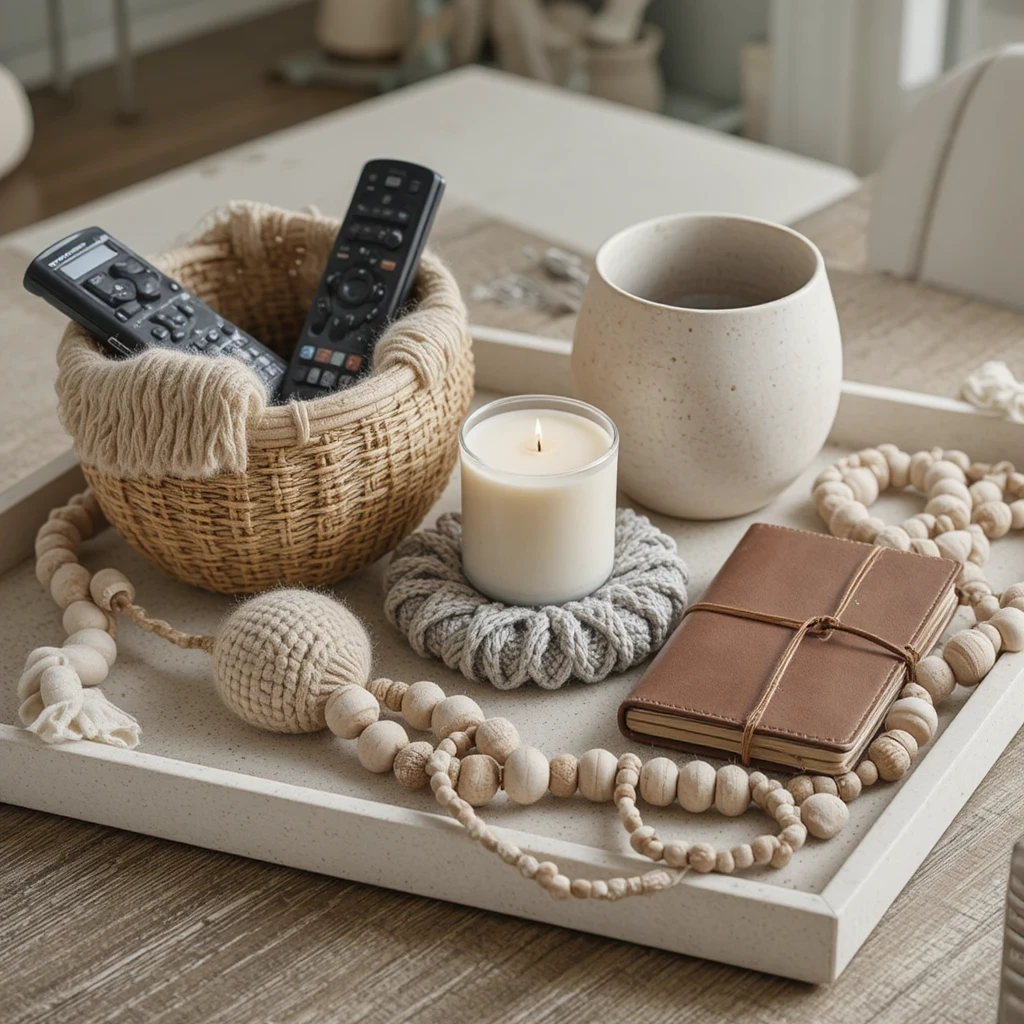
A neutral-toned tray serves as the base for an arrangement that’s all about tactile contrast: perhaps a woven basket holding remotes, a smooth ceramic vessel, a chunky knit coaster under a candle, a leather-bound notebook, and a rough-hewn wooden bead garland. Every item feels different to the touch. Shop on Amazon
Why It Works: While color catches the eye first, texture creates lasting interest and makes spaces feel rich and layered. This approach is particularly brilliant for neutral spaces where texture does all the heavy lifting—think Scandinavian design or modern farmhouse aesthetics. The varied surfaces create micro-shadows and light plays that change throughout the day as natural light shifts, making your display dynamic rather than static.
How to Style It:
- Include at least five distinct textures: smooth (glass, ceramic), rough (unfinished wood, stone), soft (fabric, leather), woven (basket, rope), and metallic (brass, copper)
- Keep the color palette neutral (whites, creams, tans, grays) so texture takes center stage without color competition
- Layer flat items under dimensional ones—a coaster under a candle, a small textile under a vase—to add depth
- Incorporate one ultra-tactile piece that begs to be touched, like a worry stone, smooth ceramic orb, or soft tassel
Where to Use It: Scandinavian-inspired spaces, modern farmhouse living rooms, neutral interiors needing depth, minimalist homes wanting warmth
Pro Tip: Visit a fabric store’s remnant bin to find small pieces of interesting textiles (linen, raw silk, chunky weave) that you can fold or drape in your tray as a textural base layer for pennies.
7. The Functional Catch-All Organization
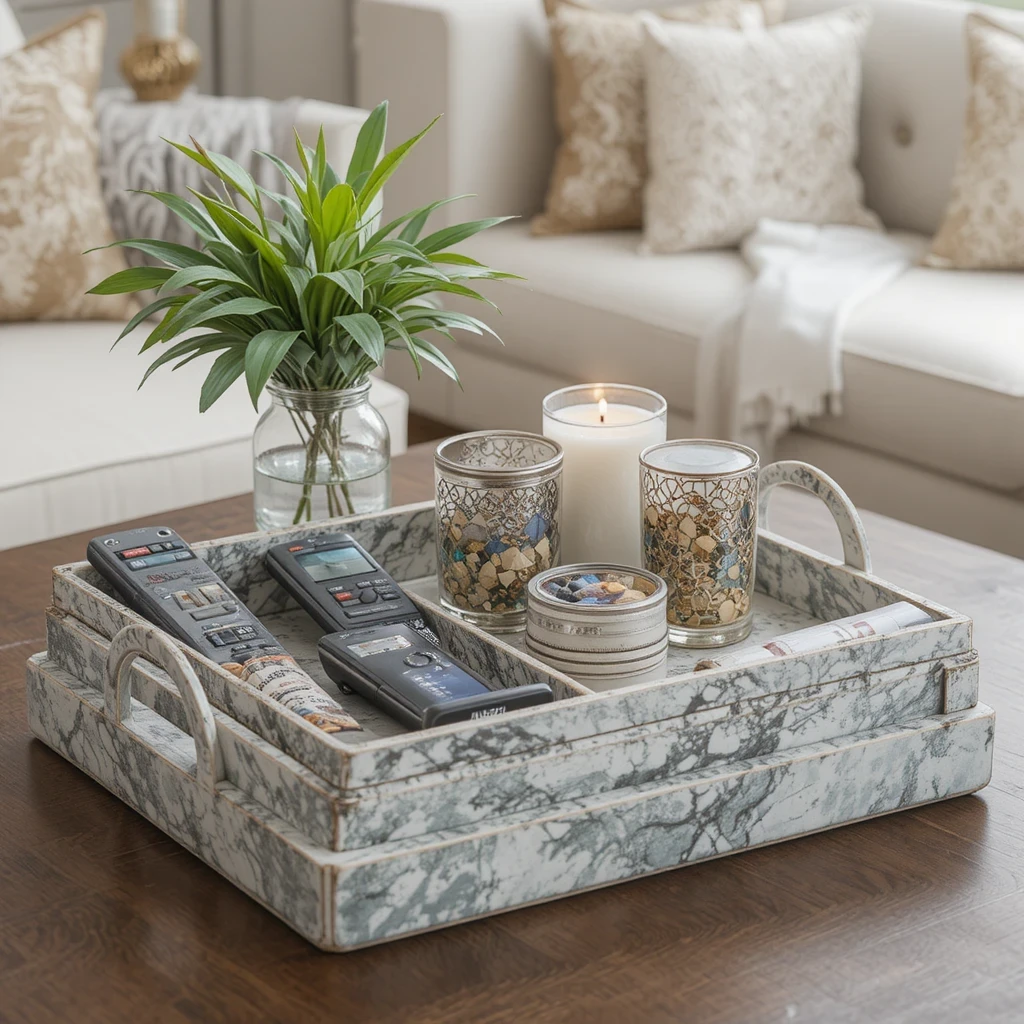
A divided or compartmentalized tray (or multiple small trays nested within a larger one) organizes everyday necessities into an attractive display: a section for remotes, a spot for coasters, a small dish for odds and ends, and perhaps a candle or small plant that makes the practical beautiful. Everything has its designated place. Shop on Amazon
Why It Works: This is the marriage of form and function—solving the universal problem of coffee table clutter while maintaining aesthetic appeal. By giving every item a home, you prevent the gradual creep of mess that happens when things get “temporarily” placed on the coffee table and never leave. It’s particularly valuable for families with children or high-traffic living rooms where the coffee table sees heavy use.
How to Style It:
- Choose a tray with raised edges (at least 1 inch) to contain items and create distinct boundaries that psychologically discourage overflow
- Designate one section for “beautiful” decor and keep it untouchable, so at least part of your display always looks magazine-ready
- Use small boxes, bowls, or compartments to corral categories: one for remotes, one for reading glasses, one for lip balm and hand cream
- Place the most-used items (remotes, coasters) closest to seating areas for intuitive functionality
Where to Use It: Family living rooms, entertainment spaces, homes with children, anywhere the coffee table is truly functional rather than purely decorative
Pro Tip: Place a small, elegant trash receptacle near the coffee table (like a decorative container) so candy wrappers, receipts, and other pocket debris have an immediate home rather than ending up in your organizational tray.
8. The Symmetrical Double Display
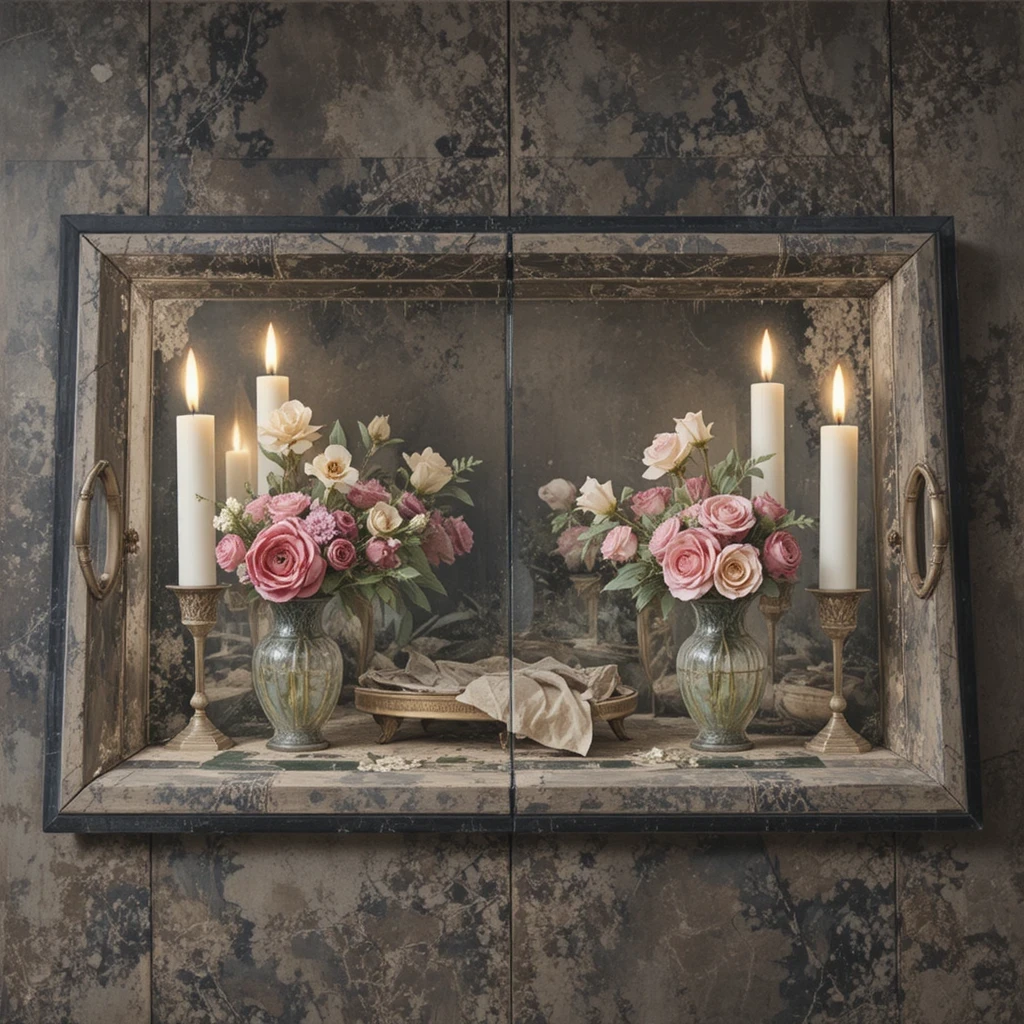
A rectangular tray is divided into two equal halves, with matching or complementary arrangements on each side: perhaps identical candles on either end with a central low element, or matching vases with similar floral arrangements flanking a central object. The effect is formal and balanced. Shop on Amazon
Why It Works: Symmetry appeals to our deep psychological preference for order and balance—it’s calming, predictable, and conveys a sense of intentional design. This approach works particularly well in traditional or formal spaces, in rooms with symmetrical architecture (matching windows, centered fireplace), or when you want your coffee table to feel like a deliberate design statement rather than a casual collection. It’s also foolproof for design beginners since the mirroring removes guesswork.
How to Style It:
- Use a rectangular tray and measure to find the exact center, then build identical or complementary arrangements on each side
- Match heights on either end for true symmetry, or vary them slightly (tall vase left, medium candle right) for informal symmetry
- Place one unifying element in the center—a low bowl, a small stack of coasters, or a flat decorative object that ties both sides together
- Keep items within each half identical or very similar in visual weight (color, size, mass) for balance
Where to Use It: Traditional living rooms, formal sitting areas, spaces with symmetrical architecture, console tables styled like coffee tables
Pro Tip: If you love symmetry but worry it looks too stiff, introduce one subtle “mistake”—one candle burned lower than its mate, or one vase with a slightly different flower—to add the human touch of “collected over time” while maintaining overall order.
9. The Seasonal Rotation Display
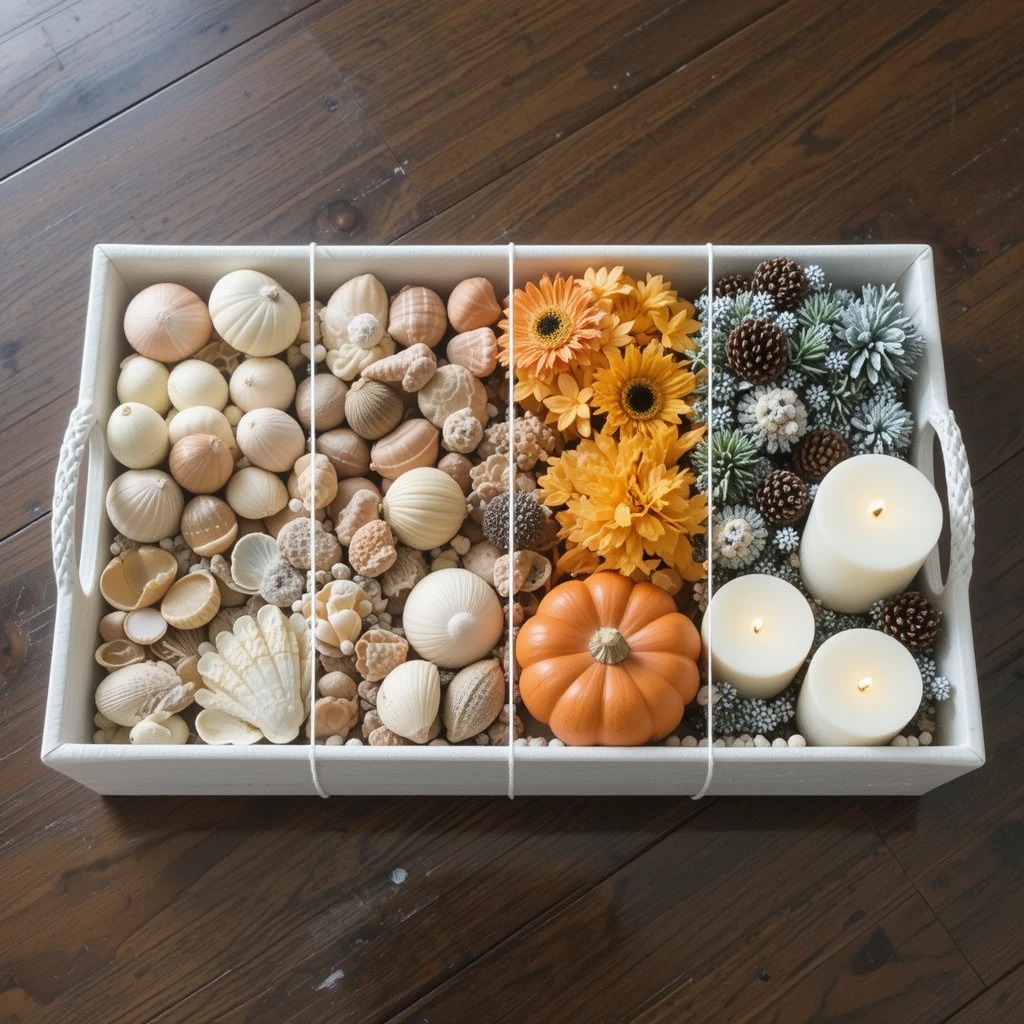
A neutral, versatile tray acts as a constant base while the objects within change throughout the year: spring bulbs and pastel accents, summer shells and bright florals, autumn pumpkins and warm metallics, winter evergreens and candles. The tray itself remains, but its contents tell the story of the season. Shop on Amazon
Why It Works: Seasonal styling keeps your space feeling fresh and current without requiring a complete room overhaul or significant budget investment. It taps into our natural attunement to seasonal cycles and creates anticipation—decorating for a new season becomes a ritual that marks time and celebrates change. It’s also practical since you’re only storing 3-4 sets of small objects rather than entire furniture pieces or large decor items.
How to Style It:
- Invest in one high-quality, neutral tray that works year-round and won’t compete with seasonal colors
- Create a “seasonal decor” storage box with sections for each season, making transitions quick and organized
- Maintain one or two constant elements year-round (like a favorite vase or set of coasters) while swapping 2-3 seasonal pieces
- Shop natural and free sources for seasonal elements: spring branches, summer garden clippings, fall leaves, winter pinecones
Where to Use It: Any living room style, homes that celebrate holidays and seasons, families with children who enjoy seasonal traditions
Pro Tip: Take a photo of each seasonal arrangement before packing it away—next year, you’ll have a reference for what worked well and won’t waste time remembering or recreating successful combinations.
10. The Gallery-Worthy Art Object Spotlight
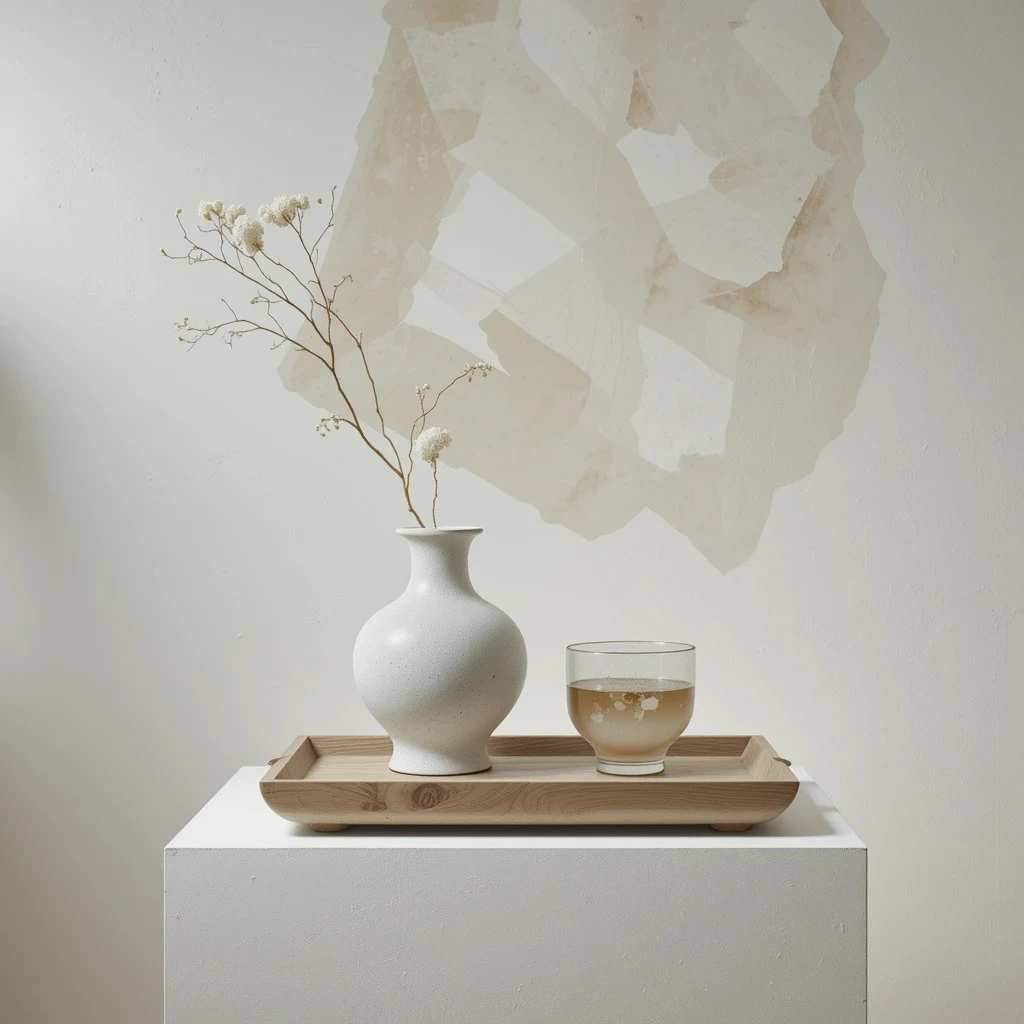
A simple, understated tray—often in a single solid color or natural material—features just one or two museum-quality objects: perhaps a beautiful ceramic vase, a small sculpture, an art glass piece, or a designer object. The tray recedes, becoming a pedestal that elevates the featured piece to art status. Shop on Amazon
Why It Works: Sometimes less truly is more—a single exceptional object commands more attention and respect than five mediocre ones. This approach works beautifully when you’ve invested in one special piece (an artist-made ceramic, a vintage find, a meaningful souvenir) that deserves solo spotlight. The restraint communicates confidence and discernment, suggesting a curator’s eye rather than a maximalist’s abundance. It’s the styling equivalent of a gallery wall with one perfectly placed painting.
How to Style It:
- Choose a tray in a contrasting texture to your object: smooth lucite under a rough ceramic, rustic wood under a sleek sculpture
- Position your object slightly off-center within the tray for dynamic visual interest rather than static centering
- Ensure your tray is at least 2-3 inches larger than your object on all sides to provide adequate breathing room
- Consider adding just one minimal companion piece if your main object is under 6 inches tall—a small dish of matches near a sculptural candle, for instance
Where to Use It: Modern and contemporary spaces, collected interiors with significant art pieces, spaces where the coffee table itself is a design statement
Pro Tip: Use this approach to rotate featured pieces from your broader collection—spend a month showcasing your vintage brass microscope, then swap it for your hand-thrown ceramic bowl—giving each treasure its moment in the spotlight.
11. The Layered Metallics Mix
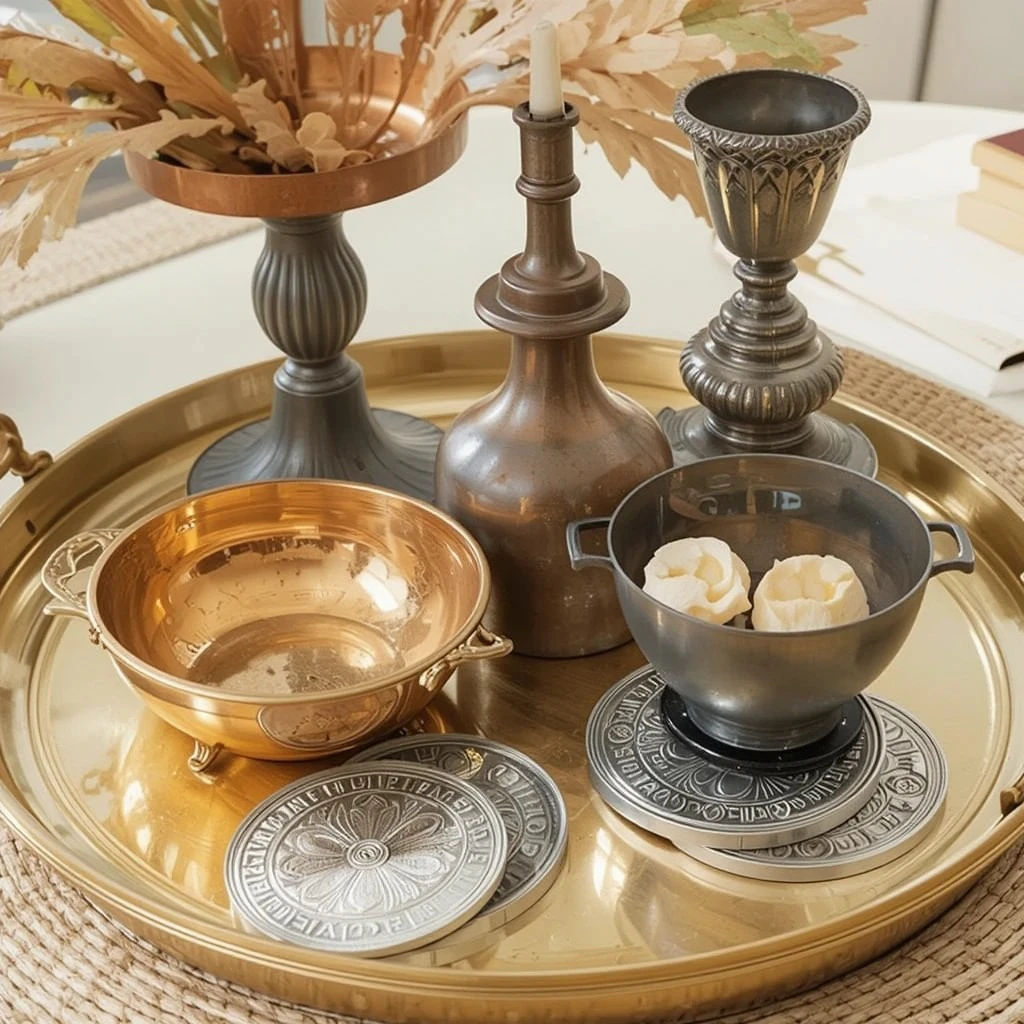
A tray in one metallic finish (brass, copper, or silver) is styled with objects in mixed metal finishes: perhaps a gold-rimmed dish, a copper candle holder, a bronze sculpture, and silver coasters. Rather than matching metals, the deliberate mix creates a collected, eclectic feel. Shop on Amazon
Why It Works: The old rule about not mixing metals is outdated—today’s most sophisticated spaces embrace the richness that comes from combining warm golds, cool silvers, and rosy coppers. Mixed metals add depth and prevent your space from looking too matchy-matchy or catalog-staged. This approach is particularly valuable for bridging different eras of furniture or accessories in your room, since mixed metals are inherently transitional and work with both traditional and modern pieces.
How to Style It:
- Include at least three different metal finishes but limit yourself to no more than four to maintain coherence
- Balance warm metals (brass, gold, copper) with cool ones (silver, chrome, nickel) for temperature variety
- Choose one dominant metal that appears in at least 40-50% of your items, with others as accents
- Vary the finishes from polished and shiny to brushed or oxidized to prevent too much glare and add textural interest
Where to Use It: Transitional spaces bridging traditional and modern, maximalist or collected interiors, living rooms with mixed-era furniture
Pro Tip: If mixing metals feels scary, start with pieces that already combine metals within themselves—a brass tray with silver handles, a candle holder with both gold and copper tones—which inherently gives you permission to add more mixed metals.
12. The Low-Profile Modern Landscape
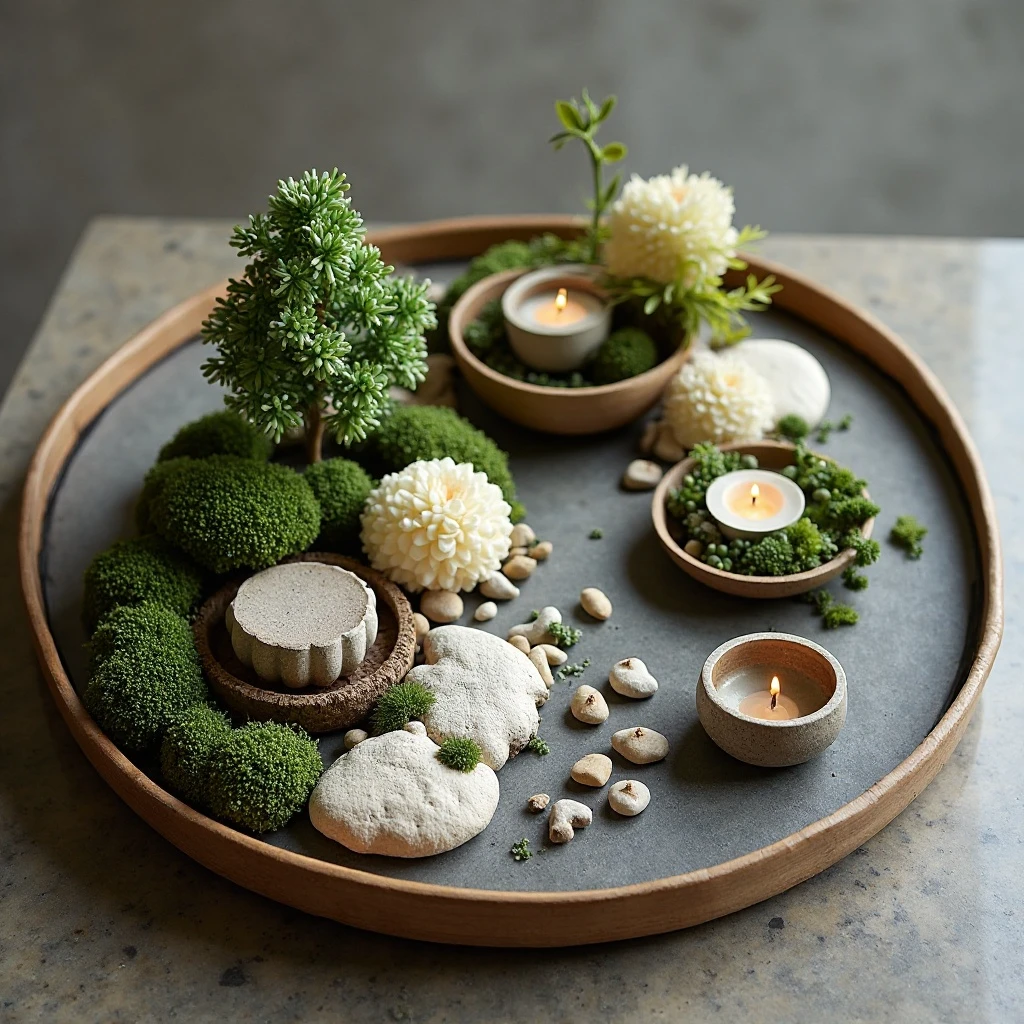
A large, flat tray (often square or circular) holds an arrangement of exclusively low-profile items—nothing taller than 3-4 inches. Think: flat stacks of coasters, a shallow bowl with decorative balls, flat candles, a spread of small stones, or a geometric dish. The effect is like a miniature zen garden or architectural site plan. Shop on Amazon
Why It Works: Low-profile styling is brilliant for maintaining sightlines in your living room—you can see over the coffee table arrangement to talk with people across from you, and it doesn’t visually divide or obstruct the space. This is essential in smaller rooms or in arrangements where the sofa and chairs face each other across the coffee table. It also creates a calming, horizontal emphasis that feels grounded and peaceful rather than busy and vertical.
How to Style It:
- Establish a maximum height of 3-4 inches and commit to it rigorously—this constraint is what makes the concept work
- Use circles and curves to soften the horizontal emphasis: round bowls, circular coasters, smooth stones rather than all rectangular boxes
- Create layers by overlapping or stacking flat items: a plate under a candle, stacked coasters, a shallow box with its lid beside it
- Employ negative space generously—aim for 40-50% of your tray surface to remain visible and empty
Where to Use It: Small living rooms, conversation areas with facing seating, modern minimalist spaces, apartments with open floor plans
Pro Tip: Visit restaurant supply stores for beautiful, affordable flat serving plates, trays, and bowls that work perfectly for this styling approach and cost a fraction of home decor store prices.
13. The Personal Collection Showcase
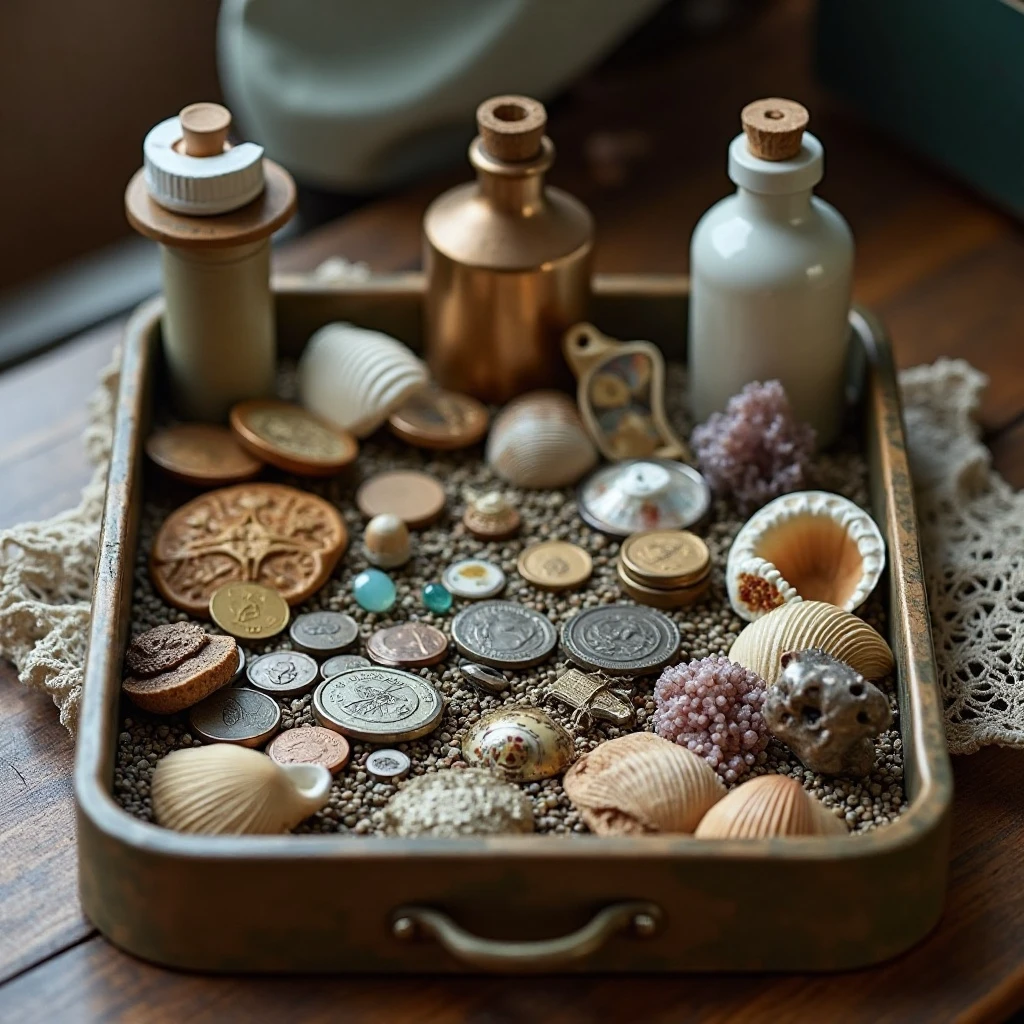
A tray becomes a mini museum for a small collection: vintage matchbooks, antique keys, small crystals or minerals, vintage bottles, foreign coins, or shells from memorable beach vacations. The collection is displayed with intention, turning a hobby into decor. Shop on Amazon
Why It Works: Your collections tell your story in a way that generic decor items never can—they’re conversation starters, memory holders, and reflections of your passions and experiences. Elevating a collection to coffee table status (rather than hiding it in a drawer or closet) honors the time and care you’ve invested in it while adding deeply personal character to your space. Guests will always gravitate toward these displays with genuine curiosity.
How to Style It:
- Curate ruthlessly—display 8-15 of your best pieces rather than your entire collection of 50+ items
- Arrange items by size, color gradient, or type to create order within variety and prevent a cluttered appearance
- Use a divided tray or small individual dishes to group like items and create organization within the collection
- Rotate pieces in and out seasonally or whenever you acquire something new to keep the display fresh and give all pieces spotlight time
Where to Use It: Eclectic or bohemian living rooms, collected interiors, homes where personal history matters more than design trends
Pro Tip: Create small typed or handwritten labels for particularly special pieces in your collection—”Santorini, 2019″ or “Grandmother’s vintage key”—placed discreetly nearby to prompt storytelling and deepen meaning.
14. The Lush Greenery Focus
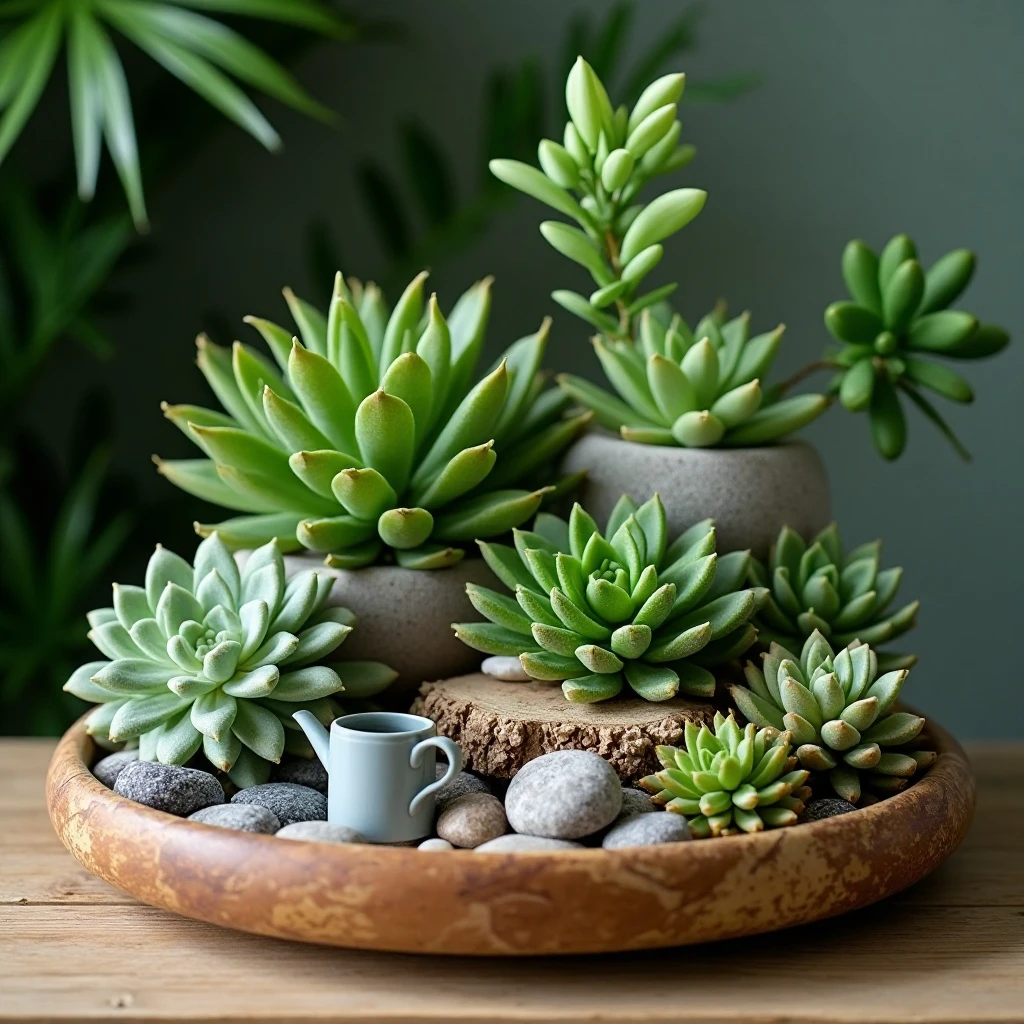
A tray (often in natural materials like wood or ceramic) centers around plants as the primary element: a statement succulent arrangement, a small potted fern, a terrarium, or a collection of air plants on driftwood. Additional elements like stones, small watering can, or natural wood pieces support the botanical theme. Shop on Amazon
Why It Works: Living plants add irreplaceable vitality to your space—they literally breathe, grow, and change, creating a living display that requires care and attention. This approach is particularly effective for bringing life to modern spaces that might otherwise feel sterile, and it works in any style from bohemian to minimalist. The green color is scientifically proven to reduce eye strain and promote calm, making your living room a more restorative environment.
How to Style It:
- Choose low-maintenance plants appropriate for your light levels: succulents for bright spaces, pothos or snake plants for low light
- Use a tray with a slightly raised lip to catch any water drips or spills during maintenance
- Group 2-3 small plants at varying heights rather than one large plant to create a mini garden effect
- Include plant-care tools as decorative elements: a small vintage watering can, a brass mister, or a dish of moss
Where to Use It: Bohemian and eclectic spaces, modern homes needing organic warmth, sunrooms or bright living rooms, any space needing air purification
Pro Tip: Protect your tray from water damage by placing cork pads, felt circles, or small ceramic saucers under plant pots—invisible from above but essential for preventing rings and water stains on both tray and table.
15. The Sophisticated Candle Cluster
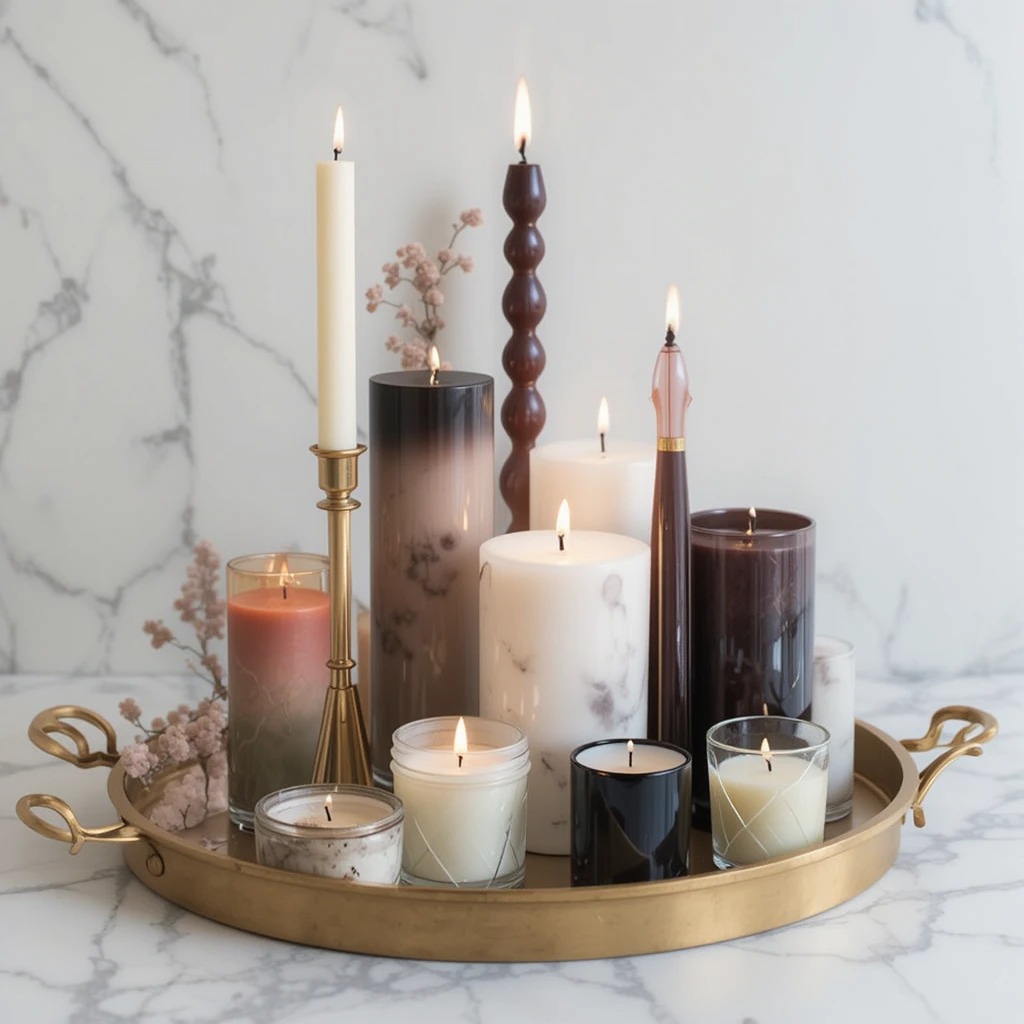
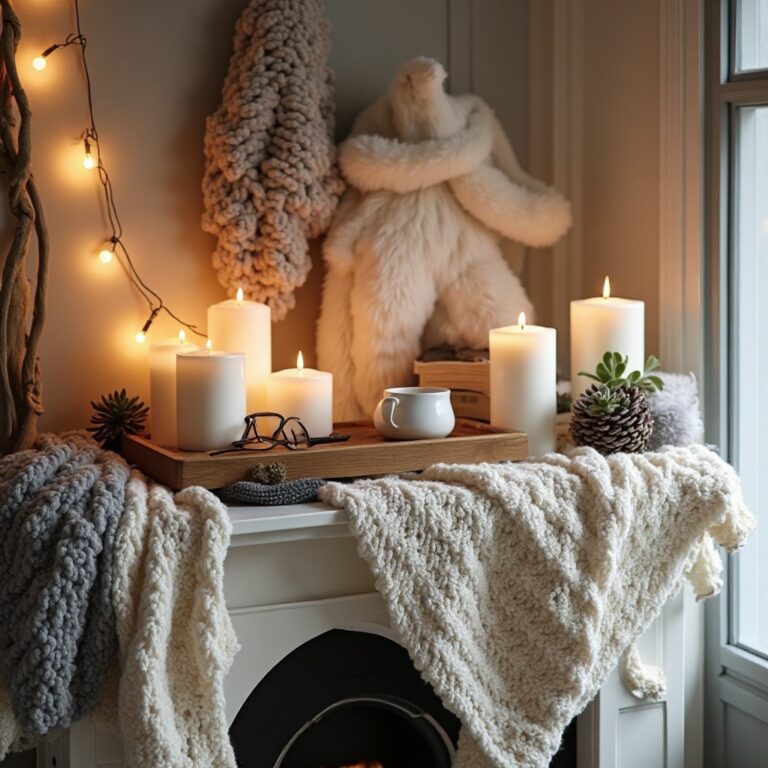
A tray holds a curated collection of candles in varying heights, widths, and styles—perhaps a tall taper in a brass holder, a chunky pillar candle, and several votives or tea lights. When lit, the effect is romantic and intimate; when unlit, the sculptural quality of the candles themselves creates visual interest. Shop on Amazon
Why It Works: Candles are the ultimate mood-setters, transforming your living room from daytime functional space to evening sanctuary with just the strike of a match. Multiple candles at different heights create dimension and drama that a single candle can’t achieve, and the warm flickering light is scientifically proven to reduce stress and create feelings of comfort. This approach also solves the “what do I do with all these random candles” problem by giving them an intentional home.
How to Style It:
- Vary heights dramatically—at least 8-10 inches between your tallest and shortest candles for maximum impact
- Stick to one candle color family (all whites and creams, or all blacks and grays) while varying the style and holder materials
- Use odd numbers of candles (3, 5, or 7) for more visually pleasing, natural-feeling arrangements
- Include at least one unscented candle if you’re using multiples, as too many competing fragrances can be overwhelming
Where to Use It: Romantic or moody spaces, living rooms used primarily in evenings, spaces lacking overhead lighting, creating ambiance for entertaining
Pro Tip: Place a lighter or elegant matches directly in your tray arrangement (perhaps in a small decorative dish) so you’re always ready to light candles without hunting for supplies—making it so easy that you’ll actually use them daily rather than saving them for special occasions.
16. The Travel Memory Display
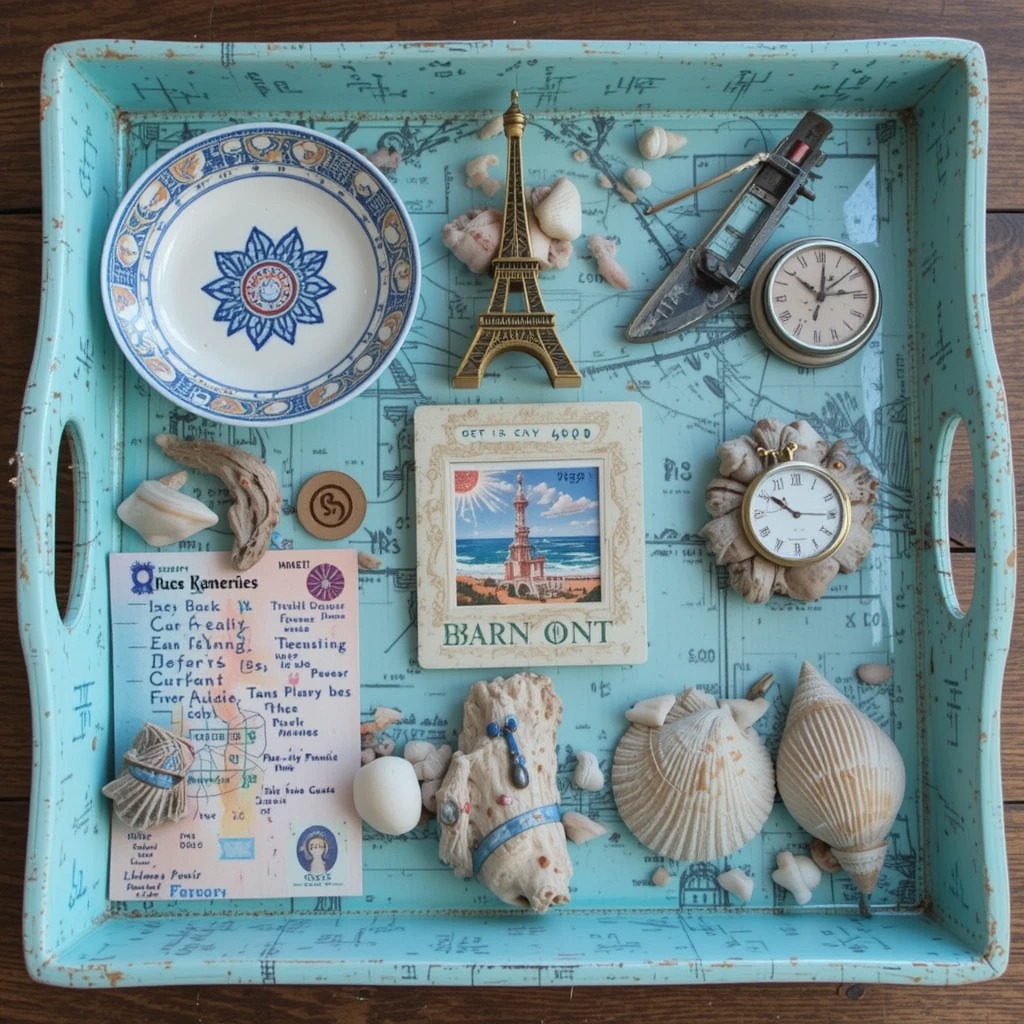
A tray becomes a passport to past adventures, showcasing small souvenirs: a small Moroccan dish, a miniature Eiffel Tower, foreign currency in a small frame, shells from a Caribbean beach, or a small piece of driftwood from the Pacific coast. Each item triggers a memory and tells part of your travel story. Shop on Amazon
Why It Works: Travel souvenirs often end up in drawers because we don’t know how to display them without looking kitschy, but a carefully curated tray arrangement solves this beautifully. By limiting quantities and displaying items with intention, you honor your experiences while creating conversation pieces that guests will ask about. It also keeps your adventures visible and present rather than forgotten, maintaining those feelings of expansion and discovery that travel brings.
How to Style It:
- Limit yourself to 4-6 small items from different trips to prevent overwhelming the tray or creating a cluttered tourist-trap aesthetic
- Choose items with similar color tones or materials to create cohesion: all natural wood, all ceramics, all metallics
- Include one larger anchor piece (a beautiful bowl, a small sculpture) and surround with smaller items for hierarchy
- Add context with a subtle label or small map segment under glass if desired, though items should be beautiful enough to stand on their own
Where to Use It: Eclectic or global interiors, collected bohemian spaces, homes of avid travelers, family rooms where memories matter
Pro Tip: Before buying travel souvenirs, photograph your coffee table tray to remember its dimensions and current styling—this helps you choose items that will actually work in your space rather than impulse-buying things that never find a home.
17. The Minimalist Single-Element Statement
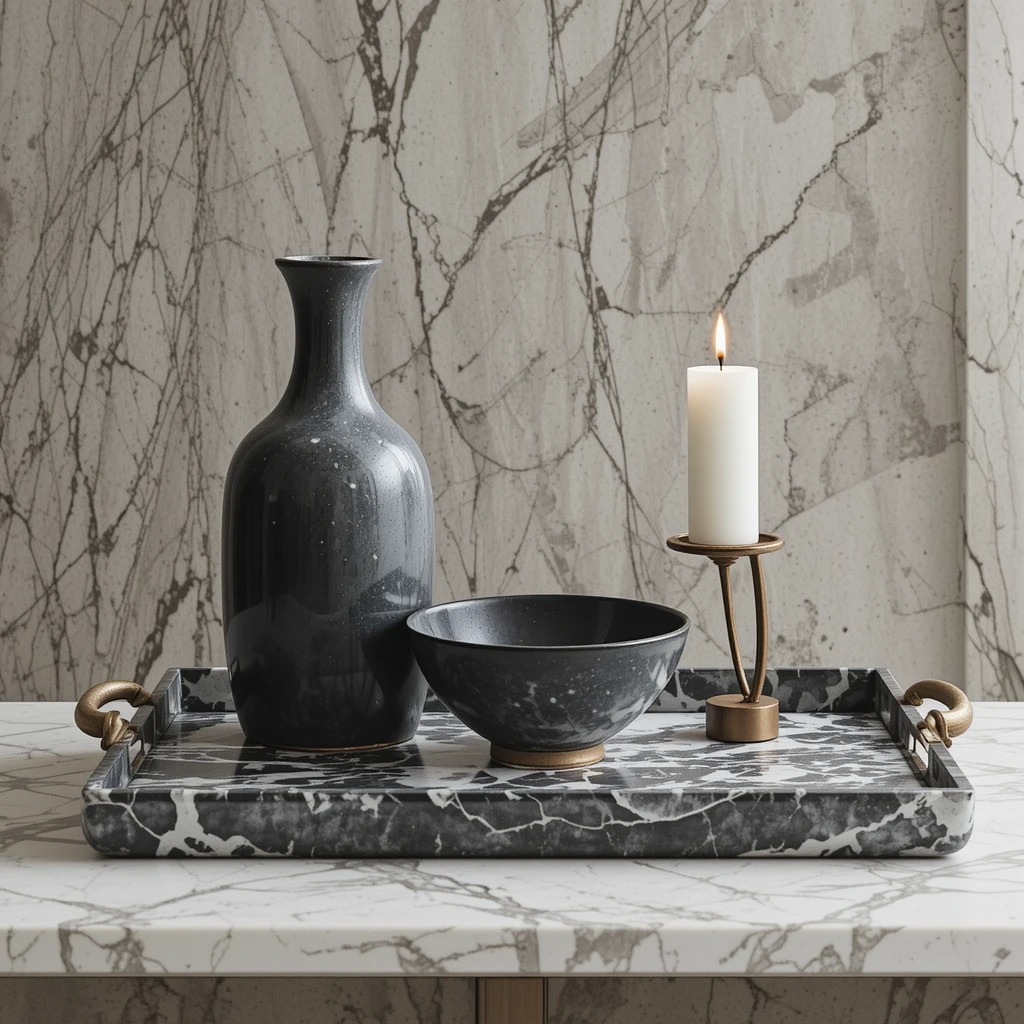
A tray—often in a dramatic material like marble, blackened wood, or brass—holds just one perfect thing: an extraordinary vase, a sculptural bowl, a significant candle in a beautiful holder, or a small but stunning art piece. The negative space is just as important as the object itself. Shop on Amazon
Why It Works: This is minimalism at its most intentional, where every element earns its place through beauty, meaning, or function. The generous negative space allows the eye to rest and the featured object to breathe, creating a sense of luxury through restraint rather than abundance. It’s particularly effective in small spaces where visual clutter would be overwhelming, or in sophisticated modern interiors where restraint communicates confidence.
How to Style It:
- Invest in one truly exceptional piece that you love looking at daily—this approach demands quality over quantity
- Choose a tray that complements but doesn’t compete: simple when your object is ornate, textured when your object is smooth
- Position your object slightly off-center and toward the back of the tray, leaving generous empty space in front
- Ensure the object is substantial enough (at least 4-6 inches in any dimension) to justify its solo status
Where to Use It: Modern minimalist spaces, small living rooms, sophisticated urban apartments, anywhere visual calm is the priority
Pro Tip: This approach is perfect for rotating special objects seasonally or monthly—feature your favorite coral specimen in summer, a brass candlestick in fall, a white ceramic vessel in winter—keeping your display dynamic while maintaining the minimalist aesthetic.
Common Mistakes to Avoid
1. Overcrowding the Tray with Too Many Small Items
The biggest tray-styling mistake is trying to fit too much into the space, creating visual chaos rather than a curated display. When every inch is filled, the eye has nowhere to rest and the overall effect reads as cluttered rather than collected. Aim to leave 30-40% of your tray surface visible and empty—this negative space is what makes the items you do display feel intentional and important. If you’re struggling to edit down, remove one item at a time until the arrangement feels like it can breathe.
2. Ignoring Height Variation and Creating a Flat, Boring Landscape
When all items in your tray are the same height, the arrangement lacks dimension and visual interest, reading as flat and uninspired. Your eye needs vertical variation to create rhythm and movement within the display. Include at least one tall element (8-12 inches), one medium element (4-6 inches), and one low element (under 3 inches) to create what designers call “the triangle of visual interest.” This height variation also ensures your display looks good from multiple angles—sitting on the sofa, standing and walking past, and from across the room.
3. Choosing a Tray That’s Too Small for Your Coffee Table
A tiny tray on a large coffee table looks apologetic and ineffective, failing to anchor the space or create visual impact. Your tray should occupy roughly one-third to one-half of your coffee table’s surface area to have proper presence and proportion. For a standard 48-inch rectangular coffee table, aim for a tray that’s 18-24 inches long. Too small, and it disappears; too large, and it leaves no functional space for actually using the coffee table for drinks, books, or feet.
4. Failing to Consider Your Coffee Table’s Material and Color
Styling a tray without considering what’s underneath it is like choosing accessories without considering your outfit. A dark wood tray on a dark wood table creates a muddy, indistinct look where the tray gets lost. Instead, create contrast: light trays on dark tables, dark trays on light tables, or use material contrast like a metallic tray on a wood table or a wood tray on a glass table. This contrast ensures your tray reads as an intentional design element rather than an afterthought or floating objects that lack grounding.
5. Using Unrelated Items with No Cohesive Story or Theme
A random assortment of objects that share no visual or thematic connection—say, a tropical shell next to a modern geometric object next to a rustic candle—creates confusion rather than cohesion. Every successful tray tells a story through a unifying element: a color palette, a material theme (all natural elements, all metallics), a style aesthetic (all modern, all vintage), or a conceptual theme (travel memories, spa serenity). Choose your thread and follow it through at least 70% of your items, allowing just one or two contrasting pieces for interest.
6. Forgetting Functionality and Creating a Display That Can’t Be Used
A coffee table tray that’s so precious and perfectly styled that you can never actually use your coffee table defeats the purpose of the furniture entirely. Your tray should accommodate real life: leave space for setting down a wine glass, ensure items can be easily moved aside when you need the surface, and avoid ultra-fragile pieces if you have children or pets. The best tray styling balances beauty with livability, looking composed yet feeling approachable. Consider creating one “untouchable” decorative section and one “functional” section within your tray for the best of both worlds.
Frequently Asked Questions
What size tray should I use on my coffee table?
The ideal tray size depends on your coffee table’s dimensions, but a good rule of thumb is that your tray should occupy one-third to one-half of the table’s total surface area. For a standard 48-inch rectangular coffee table, look for trays between 18-24 inches long. For round coffee tables, choose a rectangular tray that’s roughly one-third the diameter of the table, or a round tray that’s about 40-50% of the table’s diameter. Remember that the tray should feel substantial and anchoring without overwhelming the table or leaving no functional space—you still need room for drinks, books, and actual living.
How many items should I put in a coffee table tray?
The sweet spot for most coffee table tray is 3-5 items, following the designer’s “rule of odds” which states that odd-numbered groupings are more visually interesting than even numbers. Three items is the minimum for creating a collected look rather than a sparse one, while five items offers more complexity without crossing into cluttered territory.
That said, your tray’s size matters: a small 12-inch tray might only accommodate 2-3 items comfortably, while a large 24-inch tray can handle 5-7 items with proper spacing. Always prioritize negative space—if you need to remove items to let the tray breathe, do so.
Should my tray match my coffee table or contrast with it?
Contrast is almost always more successful than matching, as it ensures your tray registers as an intentional design element rather than disappearing into the table or looking like an unfinished part of the furniture itself. If you have a dark wood coffee table, choose a tray in light wood, white, metallics, or even a bright color.
For a glass coffee table, nearly any material will provide contrast, though metallic or wood trays work particularly well. For light wood tables, dark wood, black, or colorful trays create definition. The goal is visual clarity—you want people to immediately register the tray as a separate layer of styling rather than wondering if it’s just part of the table.
What’s the best material for a coffee table tray?
The best tray material depends on your style and lifestyle needs. Wood trays (light oak, walnut, reclaimed wood) are timeless, warm, and work with almost any decor style, though they can show water rings if not protected. Metal trays (brass, copper, silver, or black metal) add glamour and sophistication, clean easily, and work beautifully in modern or traditional spaces. Marble or stone trays feel luxurious and substantial but are heavy and can scratch.
Woven or rattan trays bring organic texture and work perfectly for casual, coastal, or bohemian aesthetics. Lucite or acrylic trays are modern and space-expanding, ideal for small rooms. Consider handles if you’ll be moving the tray frequently, and choose materials that can withstand your lifestyle—kids and pets may rule out ultra-precious materials.
How do I style a coffee table tray for everyday use versus entertaining?
For everyday use, prioritize functionality by including practical items like a decorative remote holder or basket, a place for coasters, and a candle or small plant that makes daily life more pleasant. Keep one section of the tray open or easily clearable for setting down drinks or plates.
For entertaining, temporarily remove purely functional items (remote holders, everyday clutter) and elevate the decorative elements: add flowers in a beautiful vase, light multiple candles for ambiance, includeconversation-starting objects like art books or a unique sculptural piece.
You can create a “base layer” of attractive functional items that live on the tray always, then add special decorative pieces just for guests—this makes the transition between everyday and entertaining quick and easy.
Can I use multiple trays on one coffee table?
Yes, using two or three smaller trays instead of one large tray can be an excellent styling solution, particularly on larger coffee tables (60+ inches) or square/round tables where a single tray might look lost or create awkward empty spaces. Multiple trays allow you to create distinct “zones” on your coffee table: one for decorative objects, one for functional items like remotes and coasters, one for books.
Choose trays that share a common element—similar materials, complementary colors, or the same style—so they feel cohesive rather than random. Vary their sizes slightly and avoid lining them up in a rigid row; instead, stagger them at slight angles or offset positions for a more natural, collected-over-time appearance.
Final Thoughts: Your Coffee Table, Your Story
The coffee table tray you style today doesn’t need to be perfect—it needs to be you. Whether you gravitate toward minimalist restraint or collected abundance, neutral serenity or colorful personality, the most successful tray styling reflects your authentic aesthetic and supports your actual life. Start with what you already own before buying new things, and don’t be afraid to experiment with different arrangements until something clicks.
Remember that your coffee table sits at the heart of your living room, which means it sits at the heart of your daily life—where you have morning coffee, where you put your feet up after long days, where friends gather and conversations happen. The tray you style there should enhance those moments, not complicate them. It should spark a small moment of joy when you see it while also accommodating the messy reality of living.
Give yourself permission to change your tray styling as often as you like—seasonally, monthly, or whenever inspiration strikes. Some of the best displays emerge from playful experimentation rather than rigid planning. Trust your instincts, edit ruthlessly when things feel cluttered, and always choose items that genuinely mean something to you over items that simply look good in a magazine.
Your Next Step: Look around your home right now and gather 5-7 objects you already own that you genuinely love—things you’d be happy to see every day. Arrange them on your coffee table tray (or on the table itself if you’re shopping for a tray) and live with the arrangement for a few days, adjusting as needed.
Remember: The best-styled coffee table tray is the one that makes you smile when you walk into your living room, accommodates your real life without fuss, and reflects who you actually are rather than who you think you should be.